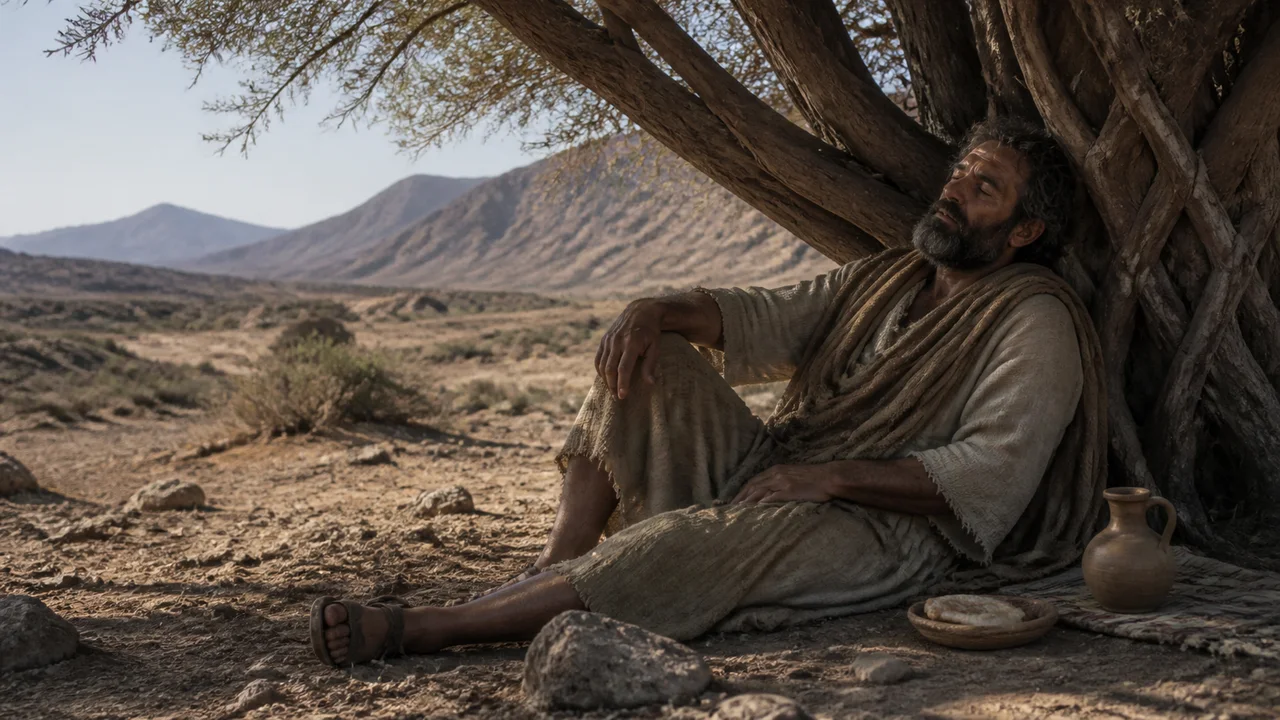
Elijah was a prophet in the northern kingdom of Israel during the reign of King Ahab. He confronted royal idolatry, announced drought, witnessed God’s provision, and challenged the prophets of Baal on Mount Carmel. Yet 1 Kings 19 also shows him frightened, exhausted, isolated, and ready to give up.
That chapter does not reduce Elijah to his lowest moment. It shows how God cares for a whole person—with food, sleep, patient questions, a revelation of His presence, truthful correction, companionship, and renewed work.
Who was Elijah?
Elijah first appears in 1 Kings 17, announcing that no rain would fall except at his word. Ahab and his wife Jezebel promoted the worship of Baal, a Canaanite deity associated with storms and fertility. The drought therefore exposed Baal’s powerlessness and confronted Israel’s divided worship.
God sent Elijah east of the Jordan, where ravens brought him food. Later he stayed with a widow in Zarephath. God provided flour and oil during famine and restored the widow’s son to life.
Elijah’s public ministry reached a dramatic point in 1 Kings 18. On Mount Carmel, he challenged the prophets of Baal. God answered Elijah’s prayer with fire, and the people confessed that the Lord is God. Rain then returned.
After such a victory, readers might expect Elijah to be fearless. The next chapter refuses that simple picture.
Elijah runs from Jezebel
When Jezebel heard what had happened, she threatened Elijah’s life. Elijah became afraid and fled south. He left his servant, traveled into the wilderness, sat under a broom tree, and asked to die.
His prayer was not triumphant: “It is enough. Now, O Yahweh, take away my life.” The prophet who had stood before a king now felt unable to continue.
The text does not tell us Elijah’s medical or psychological diagnosis, and we should not invent one. It plainly shows fear, isolation, physical depletion, and despair. James 5 later reminds readers that Elijah was “a man with a nature like ours.” His humanity is part of the biblical portrait.
Spiritual courage in one moment does not make a person unable to collapse in another. A great public success does not remove the need for sleep, food, safety, and companionship.
God begins with food and rest
God did not first answer Elijah with a rebuke or lecture. An angel touched him and said, “Arise and eat.” Elijah found bread and water, ate, and lay down again. The angel returned a second time because the journey was too great for him.
This care is striking in its simplicity. Elijah’s body mattered. God did not treat physical need as an interruption to spiritual ministry.
The passage should not be reduced to the slogan that every serious struggle can be solved by a meal and a nap. Elijah needed much more, and people in despair may need urgent professional and community care. Yet the story does correct a spirituality that ignores the body.
Sometimes the next faithful step is eating, sleeping, seeing a doctor, accepting help, or stepping away from relentless work. Human limits are not evidence that God has stopped using a person.
The journey to Horeb
Strengthened by the food, Elijah traveled forty days and nights to Horeb, another name associated with Mount Sinai, where God had made covenant with Israel through Moses.
He entered a cave, and God asked, “What are you doing here, Elijah?” The question gave him room to speak.
Elijah described his zeal, Israel’s unfaithfulness, the destruction of altars, the killing of prophets, and the threat against his own life. He concluded, “I, even I only, am left.”
Some parts of his account were true: Israel was deeply unfaithful and Elijah was threatened. But his conclusion that he was entirely alone was incomplete. Fear and exhaustion had narrowed what he could see.
God listened and then expanded the picture.
Wind, earthquake, fire, and a gentle voice
God told Elijah to stand on the mountain. A powerful wind tore at the rocks, but the Lord was not in the wind. An earthquake followed, then fire, but the Lord was not in them. After the fire came what translations describe as a gentle whisper, a low voice, or the sound of thin silence.
The passage does not teach that God is never present in dramatic events; earlier He had answered with fire on Carmel. Here, Elijah needed to recognize that God’s work was not limited to the spectacular form he had just witnessed.
God met the prophet in a quiet, personal way. Elijah covered his face and listened.
We should be cautious about claiming every inner whisper is God’s voice. Scripture, wise counsel, truth, and the character of God help us test impressions. The point is that God knew how to address Elijah and was still present when ministry no longer looked like Carmel.
God corrects Elijah’s isolation
God gave Elijah new assignments involving Hazael, Jehu, and Elisha. He also told him that seven thousand in Israel had not bowed to Baal.
Elijah was not the only faithful person left. His feeling of total isolation was understandable but inaccurate. God had been preserving people Elijah could not see.
Elisha would become Elijah’s companion and successor. The next scene shows Elijah calling him. God’s answer to isolation included a relationship and shared ministry, not merely a command to feel differently.
This does not mean lonely people are always unaware of a nearby crowd. Some truly have little support. The passage encourages us to ask whether exhaustion has hidden available help and to seek the community God may provide.
Elijah’s later story
Elijah continued his prophetic ministry. He confronted Ahab over Naboth’s vineyard, exposed injustice, and later passed his mantle to Elisha. In 2 Kings 2, Elijah was taken up in a whirlwind with chariots and horses of fire.
The Old Testament ends with a promise that Elijah would come before the day of the Lord. The New Testament connects John the Baptist’s ministry with Elijah’s prophetic role, and Elijah appears with Moses at Jesus’ transfiguration.
His story is not defined by the day under the broom tree. That day remains important, but it becomes one chapter in a longer life with God.
What we can learn from Elijah
Elijah’s story teaches that faithful people can become deeply tired and afraid. A struggle does not erase earlier faith or make future service impossible.
God’s care addresses both body and spirit. Rest, nutrition, safety, truthful conversation, community, and purpose can all matter. Seeking medical or mental-health care when despair is severe is consistent with this whole-person view.
The story also teaches us not to build faith only around dramatic experiences. God works through spectacular moments and quiet obedience. After Carmel came a meal, a question, a gentle voice, a friend, and another task.
Finally, our view may be smaller than God’s work. Elijah believed he was alone; God knew seven thousand. When you cannot see what God is doing, your vision is not the boundary of His activity.
If you are thinking about harming yourself or feel unable to stay safe, contact emergency services or a crisis service in your country now, and tell a trusted person who can remain with you. Elijah’s story should never be used to keep someone from urgent help.
Where Elijah appears in the Bible
Elijah’s main story is in 1 Kings 17 through 2 Kings 2. He is mentioned elsewhere in the Old Testament, including Malachi 4:5–6. Important New Testament references include Matthew 11:14, Matthew 17:1–13, Luke 4:25–26, Romans 11:2–4, and James 5:17–18.
Frequently asked questions
Why did Elijah run after the victory on Mount Carmel?
The text says he was afraid after Jezebel threatened his life. Physical exhaustion, danger, isolation, and disappointment form the context, but Scripture does not give a fuller diagnosis.
Was God in the “still small voice”?
The passage contrasts the wind, earthquake, and fire with the quiet sound that follows, through which God addresses Elijah. Translations differ on the exact phrase, but the scene emphasizes God’s personal, non-spectacular approach.
Did Elijah really believe he was the only faithful person?
He said he alone was left. God corrected that limited picture by revealing that seven thousand had not bowed to Baal.
Who succeeded Elijah?
Elisha became his disciple and prophetic successor. Elijah called him in 1 Kings 19, and Elisha received his mantle in 2 Kings 2.