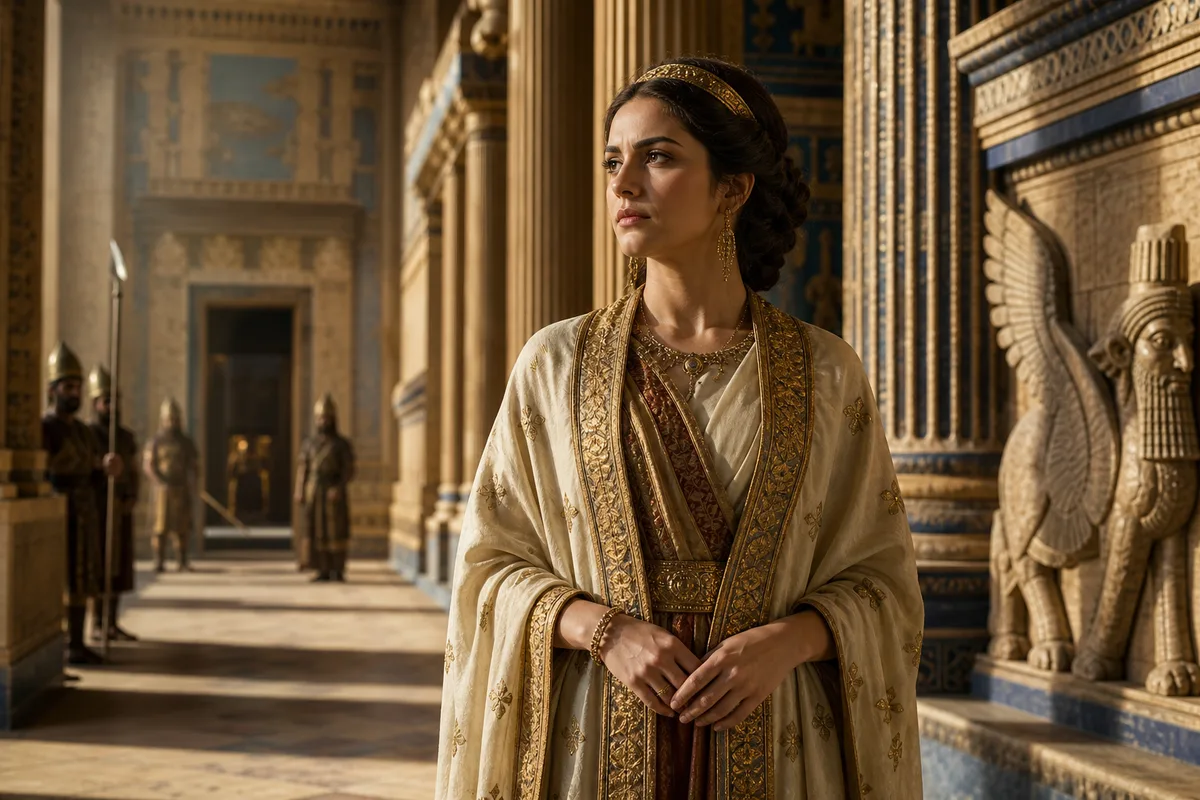
Esther was a Jewish woman who became queen of the Persian Empire and used her position to intervene when an official named Haman planned the destruction of the Jewish people. Her story combines danger, identity, careful preparation, courage, reversal, and the quiet providence of God.
The book of Esther never directly names God, yet its events repeatedly turn at precisely the moment hope seems lost. The absence of God’s name does not mean the story is godless. It invites readers to notice divine care working through ordinary choices, timing, courage, and events no character controls.
Esther’s Jewish identity and Persian setting
The story takes place in Susa during the reign of Ahasuerus, commonly identified with the Persian king Xerxes I. The Jewish people were living throughout the empire after earlier exile from their homeland.
Esther’s Hebrew name was Hadassah. She was an orphan raised by her cousin Mordecai, who treated her as a daughter. Scripture does not give Esther’s age.
After Queen Vashti was removed from her position, royal officials gathered young women for the king. Esther was taken into the palace and eventually chosen as queen. The text describes the process but does not invite us to romanticize it as a modern beauty contest. Esther lived within an imperial system where the king held enormous power.
At Mordecai’s instruction, she did not initially reveal her Jewish identity.
Mordecai uncovers a plot
Mordecai learned that two royal officials planned to kill the king. He told Esther, who reported the matter in Mordecai’s name. The plot was investigated and recorded in the royal chronicles.
At first, nothing more happened. Mordecai received no immediate reward. This seemingly unfinished detail later became central when the king could not sleep and asked for the chronicles to be read.
The book often works this way. An ordinary action appears small, then becomes part of a larger deliverance. The characters cannot see the whole pattern while living each moment.
Haman’s hatred and the decree
Haman rose to high office, and royal servants bowed before him. Mordecai refused. The text does not explicitly explain every reason for his refusal, though his Jewish identity is emphasized.
Haman became enraged. Instead of acting only against Mordecai, he sought to destroy all the Jewish people throughout the empire. He used the casting of lots—purim—to select a date and persuaded the king to authorize a decree.
The decree created grief and confusion. Mordecai tore his clothes, wore sackcloth and ashes, and wept publicly. Jewish communities fasted and mourned.
Esther was initially separated from the full reality outside the palace. Mordecai sent her a copy of the decree and urged her to approach the king.
“For such a time as this”
Esther explained the danger: anyone who entered the king’s inner court without being summoned could be put to death unless the king extended his golden scepter. She had not been called for thirty days.
Mordecai answered that palace walls would not guarantee her escape. He added that relief might arise from another place, but Esther and her family could perish. Then he asked whether she had come to royal position “for such a time as this.”
The statement is often used as though every opportunity proves a special personal destiny. In context, it is a sober call to use influence when people face mortal danger. Esther’s position brought responsibility, not merely privilege.
She did not claim certainty about the outcome. She asked the Jews in Susa to fast for three days while she and her attendants also fasted. Then she said, “I will go in to the king, which is against the law; and if I perish, I perish.”
Courage here is not absence of fear. It is action after honestly counting the cost.
Esther’s careful approach
The king extended the scepter and received Esther. Rather than immediately presenting the entire accusation, she invited the king and Haman to a banquet. At that banquet, she invited them to a second one.
The Bible does not explain every motive behind this timing. What we can see is that Esther acted patiently rather than impulsively. She created the setting in which she would make her request.
Between the two banquets, Haman’s pride grew. He ordered a high structure built to execute Mordecai. That same night the king could not sleep. When the royal records were read, he discovered that Mordecai had never been honored for exposing the assassination plot.
Haman entered intending to request Mordecai’s death, but the king asked him how to honor a man the king delighted in. Believing the king meant him, Haman designed an elaborate public honor—then had to give it to Mordecai.
The reversal had begun before Esther spoke at the second banquet.
Esther reveals the truth
At the banquet, Esther identified herself with her threatened people and asked that their lives be spared. She named Haman as the adversary.
The king reacted with anger. Haman was executed on the structure he had prepared for Mordecai, and Mordecai received Haman’s position.
Yet Haman’s death did not automatically cancel the decree, because Persian law treated a royal edict as irrevocable. Esther returned to the king, fell at his feet, and pleaded again.
A new decree allowed Jewish communities to gather and defend themselves. The book describes violent conflict and the defeat of those who attacked them. Readers should not flatten these ancient events into permission for personal revenge. The narrative concerns a threatened minority within an imperial legal crisis, not ordinary interpersonal conflict.
Purim and remembrance
The Jewish people celebrated deliverance with feasting, gladness, gifts of food, and support for the poor. The festival was named Purim after the lots Haman had cast.
Mordecai and Esther established the annual remembrance. Pain was not forgotten, but the date intended for destruction became a date for communal joy and generosity.
The book ends with Mordecai using high office to seek the good of his people and speak peace. Influence is measured by whom it protects.
What we can learn from Esther
Esther shows that courage can be careful. She fasted, prepared, chose her moment, and spoke clearly. Quick action is not always courageous, and patience is not always fear.
Her story asks how privilege can serve vulnerable people. Esther could not control the empire, but she had access others lacked. She risked that access for lives under threat.
The book also shows that identity sometimes carries cost. Esther’s hidden Jewish identity eventually had to be named. She could not save her people while permanently separating herself from them.
Providence in Esther is quiet. No sea opens and no fire falls. A sleepless night, a forgotten record, a banquet, and a courageous request become part of deliverance. We should not claim to read God’s hidden purpose behind every coincidence, but we can trust that His work is not limited to what appears dramatic.
Finally, courage does not guarantee personal safety. Esther acted without knowing whether she would survive. We should not promise that every brave choice will produce her outcome. Her example calls us to faithful action while leaving results with God.
Where Esther appears in the Bible
Esther’s story is contained in the book of Esther, chapters 1–10. She is not named elsewhere in the Protestant Old or New Testament. Greek additions to Esther appear in Catholic and Orthodox Bibles and make prayer and references to God more explicit.
Frequently asked questions
Was Esther forced to marry the king?
The text says she was taken into the royal system and later chosen as queen. It does not describe modern consent or give enough detail to make confident claims about her private feelings.
Why is God not named in Esther?
The Hebrew text never directly names God. Rather than proving divine absence, the narrative invites readers to perceive providence through reversals, timing, and faithful human action.
What does “for such a time as this” mean?
Mordecai challenges Esther to consider whether her position has placed a responsibility before her during a crisis. It is not a general promise that every ambition is a divinely appointed destiny.
What is Purim?
Purim is the Jewish festival remembering deliverance from Haman’s plan. Its name refers to the pur, or lot, used to choose the planned date of destruction.