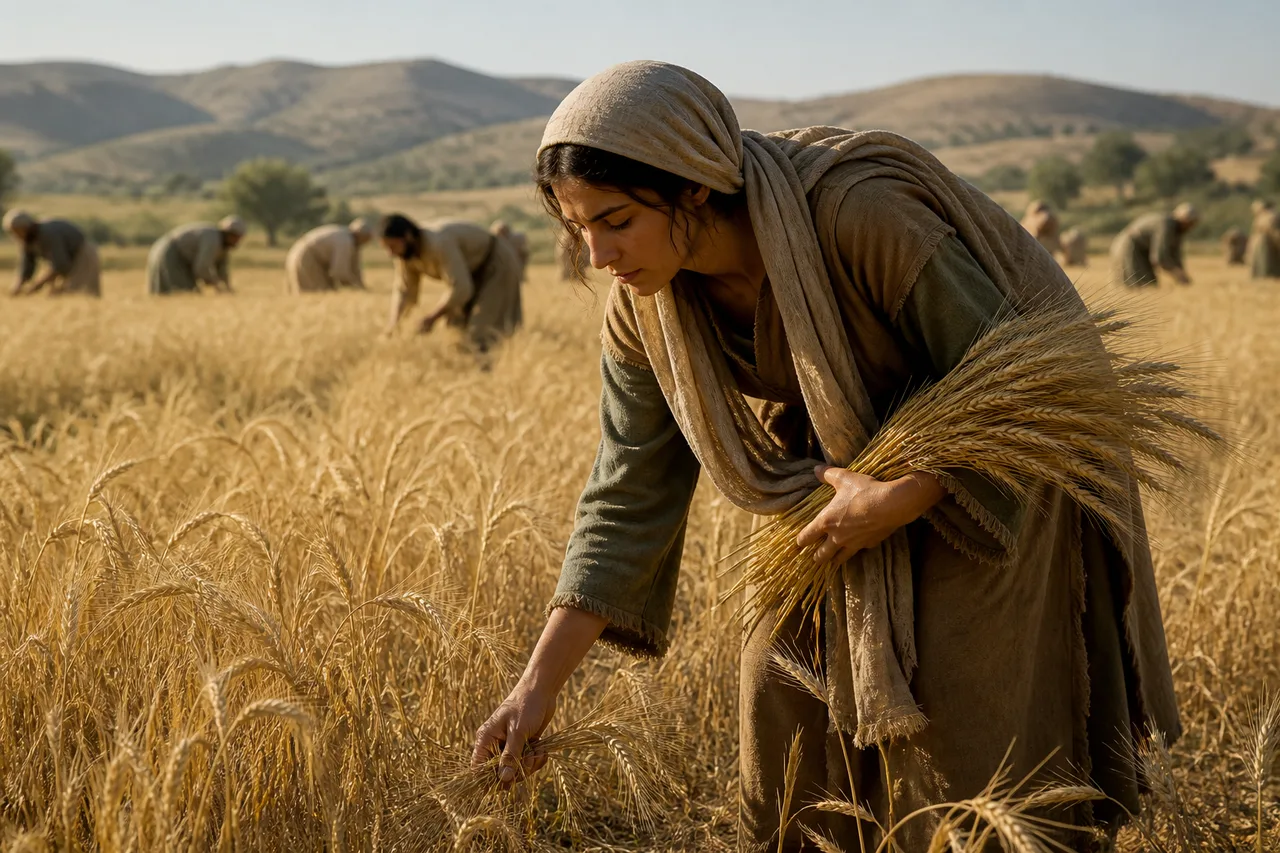
Ruth was a Moabite widow who chose to remain with her Israelite mother-in-law, Naomi. She traveled to Bethlehem, gathered leftover grain to provide food, married Boaz, and became the great-grandmother of King David. Matthew’s Gospel later names her in the family line of Jesus.
Her story is told in the four chapters of the book of Ruth. It is a human account of bereavement, migration, poverty, work, kindness, family responsibility, and God’s quiet providence.
Ruth’s life in Moab
The story begins during the time of the judges, a troubled period in Israel’s history. A famine led Elimelech, his wife Naomi, and their two sons from Bethlehem to the land of Moab.
Elimelech died. The sons married Moabite women named Orpah and Ruth, but about ten years later both sons also died. Naomi, Ruth, and Orpah were left as widows.
In that ancient setting, widowhood often created severe economic and social vulnerability. The book does not tell us Ruth’s age, what her marriage had been like, or every detail of her grief. We should not invent those things. It tells us enough to see three women facing a future they had not chosen.
When Naomi heard that food had returned to Judah, she decided to go home.
Ruth’s promise to Naomi
Naomi urged her daughters-in-law to remain in Moab and build new lives. Orpah said a tearful goodbye. Ruth stayed.
Her words have become among the best known in Scripture: “Where you go, I will go; and where you stay, I will stay. Your people will be my people, and your God my God” (Ruth 1:16).
These words are sometimes used at weddings, but in their original setting they are spoken by a widowed daughter-in-law to another widow. Ruth commits herself to Naomi, to Naomi’s people, and to Israel’s God without knowing whether Bethlehem will welcome her.
Her loyalty is not sentimental. It carries practical cost. She leaves her country and familiar community. As a Moabite woman in Judah, she will be a foreigner. Ruth chooses a shared uncertain future rather than letting Naomi face it alone.
Arrival in Bethlehem
Naomi and Ruth reached Bethlehem at the beginning of the barley harvest. Naomi asked to be called Mara, meaning “bitter,” because she felt the Almighty had dealt bitterly with her.
The Bible allows Naomi to speak from grief. No narrator immediately corrects her feelings. At the same time, the reader can see details Naomi cannot yet interpret. Ruth is beside her, and harvest has begun.
This does not make Naomi’s losses small. It shows how the story can contain real bitterness and the first quiet signs of provision at once.
Ruth asked permission to glean. Israel’s law required landowners to leave portions of a harvest for poor people, immigrants, widows, and others without land. Gleaners followed the workers and gathered what remained. It was hard and uncertain work, but it gave vulnerable people access to food with dignity.
Ruth meets Boaz
Ruth happened to glean in a field belonging to Boaz, a relative of Elimelech. The narrator’s simple “happened” invites readers to notice providence without turning every ordinary event into a miracle claim.
Boaz had heard about Ruth’s loyalty to Naomi. He told her to remain with his workers, instructed the men not to harass her, gave her water and food, and ordered that extra grain be left for her.
His protection matters. Ruth was not only poor; she was a foreign woman working outdoors among strangers. Boaz used his position to create safety and provide more than the minimum required by law.
Ruth responded with humility and surprise: why had she found favor as a foreigner? Boaz blessed her for seeking refuge under the wings of Israel’s God.
The book shows God’s care arriving through ordinary faithfulness: a law that protects the poor, Ruth’s labor, Naomi’s knowledge, and Boaz’s generosity.
The role of a family redeemer
Naomi identified Boaz as a close relative and a potential “redeemer.” In this context, a family redeemer was a relative able to protect family property and interests when poverty or death placed them at risk.
The legal and social customs in Ruth 3–4 are distant from modern marriage practices. Naomi instructed Ruth to approach Boaz at the threshing floor and ask him to spread his garment over her, a request for protection and redemption.
Boaz treated the request seriously. He did not take advantage of Ruth. He explained that another relative had a prior claim and promised to settle the matter openly.
At the town gate, where legal business was conducted, Boaz gathered elders and spoke with the nearer relative. When that man declined, Boaz accepted the responsibility before witnesses.
Ruth, Boaz, and Obed
Ruth married Boaz and gave birth to a son named Obed. The women of Bethlehem celebrated with Naomi and recognized that the child brought hope to her family.
Obed became the father of Jesse and the grandfather of David. The book that began with famine, death, and an uncertain journey ends by placing Ruth within Israel’s royal story.
Matthew 1 goes further. Ruth is one of the women named in the genealogy of Jesus. A Moabite widow, once an outsider gathering leftover grain, is remembered as an ancestor of the Messiah.
The text does not say Ruth understood the future importance of every ordinary choice. She simply acted with loyalty, courage, and diligence within the day she had.
What we can learn from Ruth
Ruth teaches that faithful love becomes practical. Her promise to Naomi is followed by travel, work, shared food, and long-term commitment. Loyalty is more than warm words.
Her story also shows the dignity of immigrants and vulnerable people. Ruth is repeatedly called “the Moabite,” yet her origin does not exclude her from God’s unfolding purposes. God’s people are called to welcome and protect rather than exploit those with less power.
Boaz demonstrates that biblical kindness uses available power for another person’s good. He respects Ruth, creates safety, follows a public process, and acts generously.
Naomi’s story reminds us that grief may speak bitterly without ending the story. We should not quote the ending at grieving people as a quick solution. The book gives Naomi time, companionship, food, community, and renewed hope.
Finally, Ruth shows providence working quietly. There is no dramatic miracle in the book. God’s care is seen through harvest, law, work, relationship, and timing. Ordinary faithfulness can belong to a story much larger than the person living it can see.
Where Ruth appears in the Bible
Ruth’s story is found in the book of Ruth, chapters 1–4. She is mentioned in Matthew 1:5 as an ancestor of Jesus. Her family connection to David is summarized in Ruth 4:17–22 and echoed in the biblical genealogies.
Frequently asked questions
Was Ruth an Israelite?
No. Ruth was from Moab. She joined Naomi’s people and confessed faith in Naomi’s God. The book repeatedly remembers her foreign origin.
Was Boaz Ruth’s closest relative?
No. Ruth 3–4 says another relative had a prior right. Boaz followed the legal process, and the nearer relative declined before Boaz became the redeemer.
Why is Ruth important in the story of Jesus?
Ruth became an ancestor of David, and Matthew includes her in Jesus’ genealogy. Her presence highlights God’s grace working through a foreign widow within the Messiah’s family line.
What does Ruth’s name mean?
The precise origin and meaning are uncertain. It is often connected with friendship or companionship, but the Bible itself does not explain her name, so the meaning should not be treated as certain.