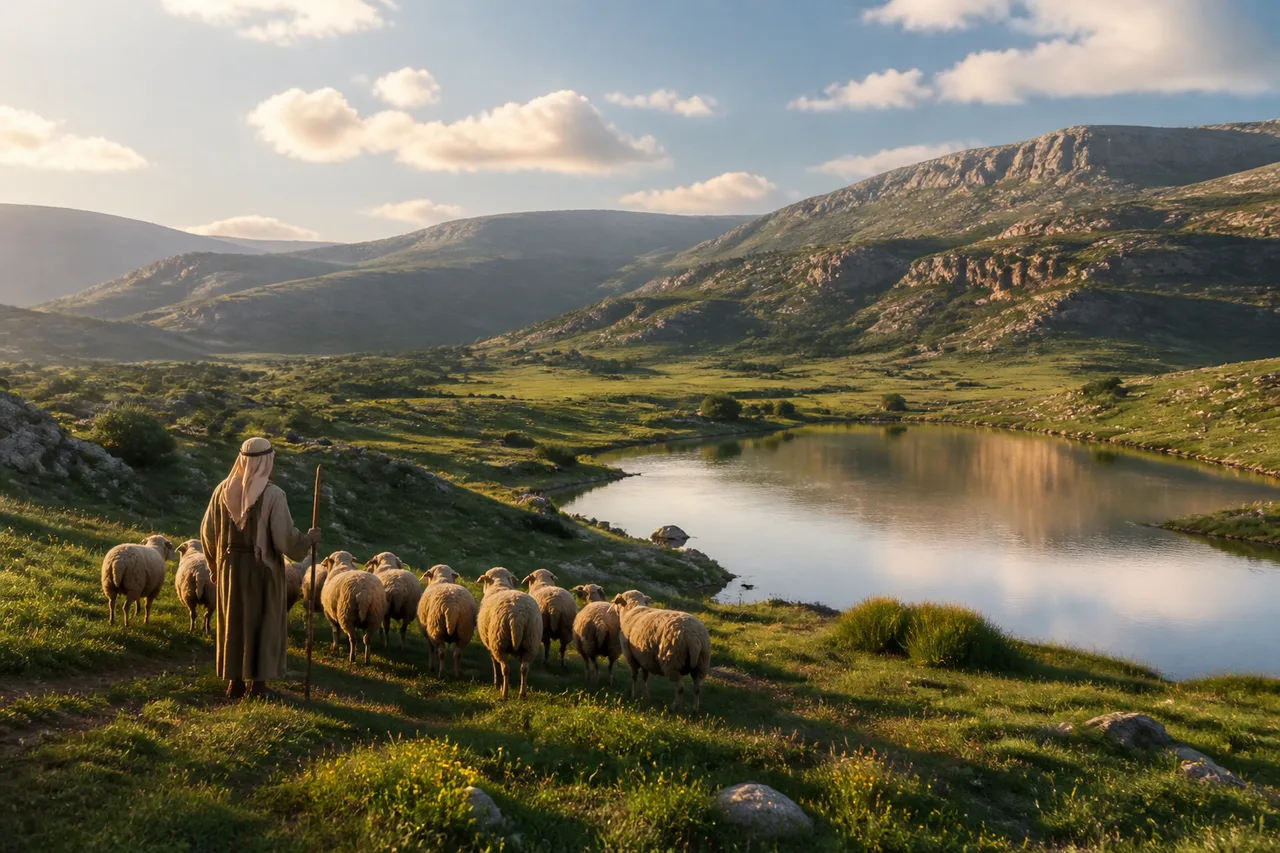
“Yahweh is my shepherd: I shall lack nothing.” — Psalm 23:1, World English Bible
Psalm 23 describes God as a shepherd who provides, guides, protects, welcomes, and brings His people home. It does not promise a life without danger. Its comfort is that the Shepherd remains present in green pastures and in the darkest valley.
What Psalm 23 means
David begins with a personal confession: “Yahweh is my shepherd.” In the ancient world, a shepherd led sheep to food and water, guarded them from danger, searched when they wandered, and stayed near a flock that could not safely guide itself.
Calling God a shepherd is therefore a statement of dependence and trust. David is not claiming that every desire will be satisfied. “I shall lack nothing” means the Shepherd will not fail to provide what is truly needed for the path He gives.
David had known hunger, danger, conflict, and grief. The line cannot mean that faithful people never experience loss. It means lack and danger do not remove them from God’s care.
The setting and shape of the psalm
Psalm 23 is attributed to David, who worked as a shepherd before becoming king. The poem does not identify one event from his life. Its images gather a lifetime of trust into six short verses.
The first four verses picture God as a shepherd. In verse five, the image changes: God is a generous host who prepares a table and welcomes the psalmist as an honored guest. The final verse looks beyond one difficult day toward a lifetime—and ultimately a home—with God.
The movement matters. The psalm travels from open pasture through a dark valley, into a place of welcome, and finally toward the Lord’s house. Trouble is part of the route, but it is not the destination.
“He makes me lie down in green pastures”
“He makes me lie down in green pastures. He leads me beside still waters. He restores my soul.” — Psalm 23:2–3
Green pasture and quiet water represent provision, safety, and rest. Sheep lie down when they are not searching desperately for food or reacting to danger. The shepherd has brought them to a place where rest is possible.
“He restores my soul” can also carry the sense of restoring life or bringing someone back. God’s care is not merely a pleasant feeling. He renews the person who is depleted and redirects the one who has wandered.
This does not turn rest into a reward for finishing every task. Rest is part of the Shepherd’s provision. If you are exhausted, receiving sleep, food, medical care, companionship, or a quiet hour can be a faithful act rather than a selfish interruption.
“He guides me in the paths of righteousness”
The Shepherd not only comforts; He leads. “Paths of righteousness” are right paths—ways consistent with God’s character and will.
Guidance in this verse is not mainly about finding secret signs for every personal decision. It is about being led into a life that bears God’s name well. Truthfulness, mercy, justice, faithfulness, and love are not side roads. They are part of the path.
The words “for his name’s sake” place confidence in God’s reputation, not David’s skill. A shepherd’s care reflected on his name. David trusts God to act faithfully because God is faithful.
“Though I walk through the valley of the shadow of death”
“Even though I walk through the valley of the shadow of death, I will fear no evil, for you are with me.” — Psalm 23:4
The Hebrew expression can mean a valley of deep darkness. It includes the threat of death but can also describe any place where the way is obscured and danger feels near.
The psalm does not say believers avoid the valley. David walks through it. Faith does not deny the diagnosis, bereavement, uncertainty, or threat. It names a stronger reason not to be ruled by fear: “You are with me.”
At this point David stops speaking about God as “he” and speaks directly to Him as “you.” The darkest place becomes the most personal part of the prayer.
The rod and staff were tools of protection and guidance. Their comfort lies in the Shepherd’s active presence. The verse does not guarantee that nothing painful will happen. It assures God’s people that darkness is not abandonment.
“You prepare a table before me”
The scene changes from pasture to table. God welcomes David in the presence of enemies. The enemies have not vanished, yet they do not control the meal or cancel the host’s care.
Anointing with oil was associated with welcome and honor. An overflowing cup pictures generosity. David sees himself not as an unwanted person barely tolerated by God, but as a guest received abundantly.
This image corrects the idea that peace can begin only after every conflict ends. God can nourish courage and restore dignity while trouble remains visible.
It does not mean we should stay in unsafe situations. Seeking protection, justice, and help can be wise. The verse’s point is that hostile voices do not have final authority over the worth and welcome God gives.
“Goodness and loving kindness shall follow me”
The word translated “loving kindness” refers to God’s steadfast covenant love. David expects God’s goodness and faithful love to pursue him throughout his life.
This is more active than a vague wish that things will improve. The Shepherd who has led him so far will not suddenly become unfaithful. Even when David cannot see goodness ahead, he trusts that God’s loyal love is behind and around him.
The final hope is to dwell in the Lord’s house for length of days. For Christians, this hope finds fuller light in Jesus, the Good Shepherd who lays down His life for the sheep and gives eternal life (John 10).
What Psalm 23 can say to you today
Read the psalm slowly and notice where you are in its images. You may need permission to rest in the pasture. You may need guidance onto a right path. You may be walking through deep darkness. You may need to remember that accusation and hostility cannot remove God’s welcome.
Do not force the whole psalm into a promise that today’s problem will disappear. Receive its central promise: the Shepherd is present and faithful through the whole journey.
Choose one line and turn it into prayer. “Lead me.” “Restore me.” “You are with me.” “Let me receive Your welcome.” The psalm gives simple words when your own are difficult to find.
An idea to remember
The dark valley is part of the path, but the Shepherd has not left it.
Frequently asked questions
Does “I shall lack nothing” promise material wealth?
No. David himself experienced hardship. The phrase expresses confidence in the Shepherd’s sufficient care, not a guarantee of every comfort or desire.
What is the valley of the shadow of death?
It is a poetic picture of deep darkness and danger, including the threat of death. The focus is not identifying one location but trusting God’s presence when the path becomes frightening.
Who is the Good Shepherd in the New Testament?
Jesus calls Himself the Good Shepherd in John 10. He knows His sheep, lays down His life for them, and gives them eternal life, bringing the imagery of Psalm 23 into the center of the gospel.